Vehicle components delivery and public-road demonstration in Türkiye
The Istanbul pilot demonstrates Ford Otosan’s 16-tonne electric distribution truck under real public-road operating conditions in Türkiye. Ford Otosan combines a lightweight modular vehicle platform, advanced thermal management, Digital Twin integration and eco-driving functions to validate zero-emission delivery logistics while benchmarking payload, range, energy consumption and thermal efficiency against a reference vehicle.
Objectives
Key Objectives of the Pilot Project
Demonstrate zero-emission delivery logistics on public roads, with daily round-trip operation around 400 km in the final demonstration phase
Validate at least 200 km average daily operation over a six-month demonstration period under real operating conditions.
Benchmark the 16-tonne NextETRUCK vehicle against a 19-tonne baseline vehicle, focusing on payload retention, energy consumption and operational feasibility.
Use Digital Twin correlation and public-road data analysis to quantify energy efficiency benefits and validate project KPIs.
Develop and demonstrate a lightweight modular electric platform, including an aluminium ladder frame, optimized battery packaging, e-axle integration and advanced thermal management.
“Market research indicates that electrifying smaller trucks is a strategic entry point due to their operational profiles and simpler technology integration. Electric trucks also offer strong potential in urban environments, making a 16-tonne electric distribution truck a valuable starting point for technology advancement in this sector.”
Mustafa Başaran, Pilot Leader
Senior Technical Leader at Ford Otomotiv Sanayi A.S.
Innovations
NextETRUCK Innovations
Lightweight modular electric platform based on an aluminium ladder frame and optimized bracket structures.
E-axle based powertrain architecture, selected to reduce mass, packaging volume and mechanical losses compared with central drive alternatives.
Digital Twin connected vehicle framework for correlating simulation results with vehicle test data and supporting efficiency benchmarking.
Advanced thermal management, including improved thermal system modelling and vehicle-level thermal efficiency validation.
Eco-driving and route optimization functions, including predictive speed planning and vehicle control integration.
Lower cabin concept, EPS demostration, 19.5-inch wheel strategy, improved battery packaging and Software Defined Vehicle readiness as longer-term Ford Trucks technology building blocks.
Partners
Collaborating Partners and Defined Roles
OEM and vehicle operator
(+ Thermal system concept and control)
Digital Twin thermal
Cabin thermal model
Powertrain eco-driving
Data analysis and KPI evaluation
The Truck
Overview of the Ford Otosan Electric Truck
The Ford Otosan Truck
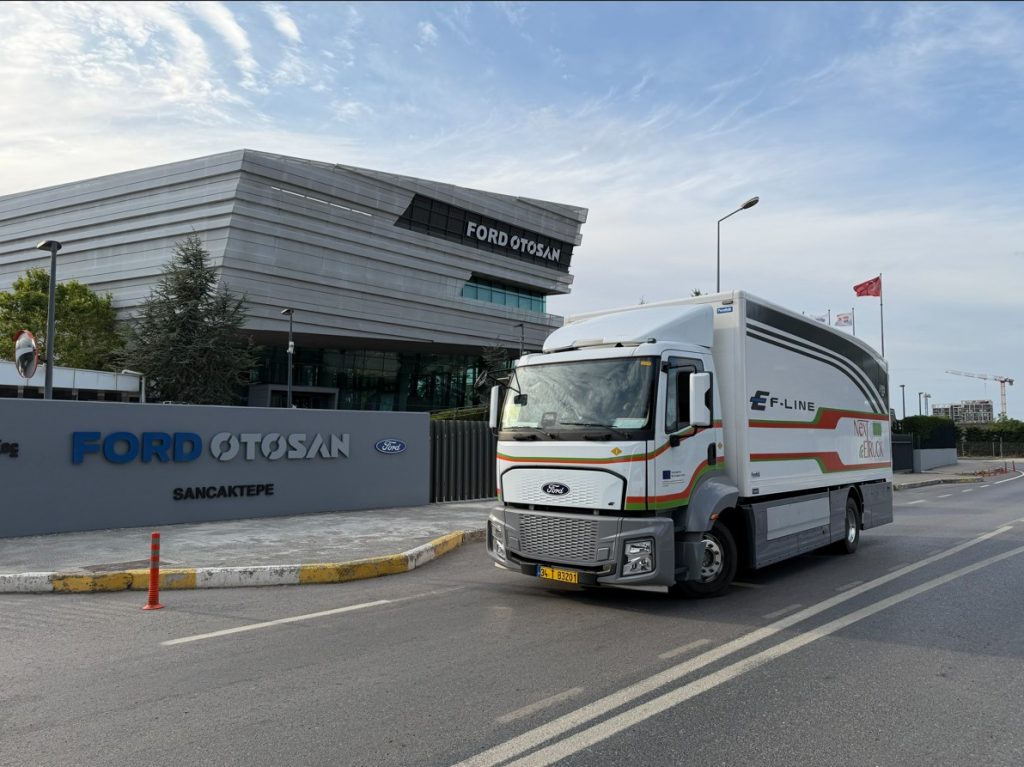
Ford Otosan’s Truck is a 16-tonne electric distribution truck developed as a born-electric lightweight and modular platform.
The platform includes an aluminium ladder frame, optimized battery packaging, an e-axle, advanced thermal management, Digital Twin integration and vehicle control functions for eco-driving.
Project materials highlight a target/achieved vehicle concept around approximately 5,938 kg curb weight, support for a 10-tonne payload target, and approximately 1,650 kg weight reduction in the broader roll-up material.
The vehicle is used to validate Ford Otosan’s technology building blocks for future electric truck platforms, including modular architecture,Software Defined Vehicle readiness and reusable Digital Twin infrastructure.
Diversity & Inclusion
The Istanbul pilot contributes to Horizon Europe’s broader diversity and inclusion objectives by actively involving women drivers in demonstration activities.
Beyond validating vehicle performance under real operating conditions, the pilot aims to encourage wider participation in the heavy-duty transport sector, improve visibility of underrepresented groups and collect operational feedback from a diverse driver community.
Charging Specs
Charging strategy: depot and route-based public-road testing, with current public-road endpoints selected close to charging stations near the Gölcük route.
THE ROUTE
The Truck's Route in Istanbul
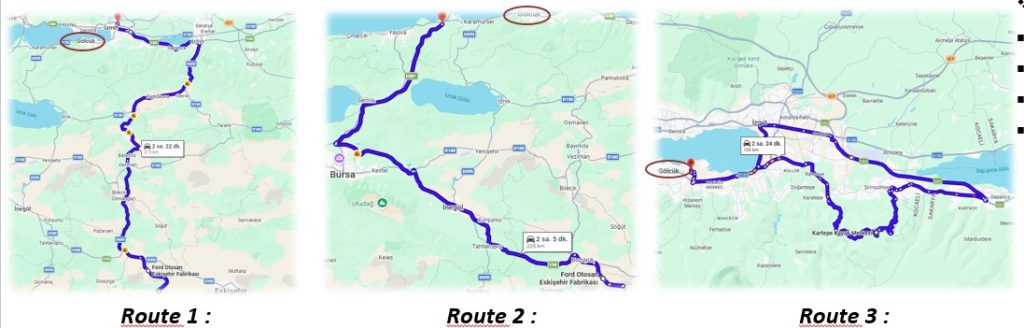
The Istanbul use case was originally defined around Ford Otosan’s Gölcük and Eskişehir production sites, using intercity and urban road sections to expose the vehicle to different traffic, altitude, topology and weather conditions.
Route endpoints are currently defined at charging stations near the Gölcük Plant because Ford Otosan operates with dummy payloads and does not require entry into the plant premises.
Route 1
Eskişehir to Gölcük, with a charging-station endpoint near İzmit Mars Shopping Center, approximately 420 km round trip in the current public-road test setup.
Route 2
Eskişehir to Gölcük, with a charging-station endpoint near Altınova Oksijen, approximately 400 km round trip in the current public-road test setup.
Route 3
Route 3 can be retained as a high-altitude and low-temperature scenario, using the Gölcük to Kartepe route concept to evaluate vehicle performance under more demanding climatic and elevation conditions.
Innovations
Key achievements and current status
Public-road approval was secured after brake tests at IDIADA in Spain, followed by vehicle preparation, general checks and initial Digital Twin integration.
Public-road approval was secured after brake tests at IDIADA in Spain, followed by vehicle preparation, general checks and initial Digital Twin integration.
Back-to-back comparison tests were conducted between the baseline vehicle and the NextETRUCK Ford Otosan across Route 1 and Route 2.
Baseline and NextETRUCK loading conditions demonstrated approximately 90% payload retention compared with the reference vehicle.
Baseline and NextETRUCK loading conditions demonstrated approximately 90% payload retention compared with the reference vehicle.
The final demonstration phase focuses on long-term public-road operation, Digital Twin correlation and quantification of real-world energy efficiency benefits through September 2026.