

The NextETRUCK consortium presented the results of the project during its Final conference held on 28 September 2026 in Brussels. Around 50 stakeholders attended, including European Commission officials, original equipment manufacturers (OEMs), AEVETO cluster partners and technical specialists. The event was organised alongside the Connecting Europe Days, the flagship event of the European Comission in Transport and Mobility, bringing together each year more than 4,000 experts from the transport sector.
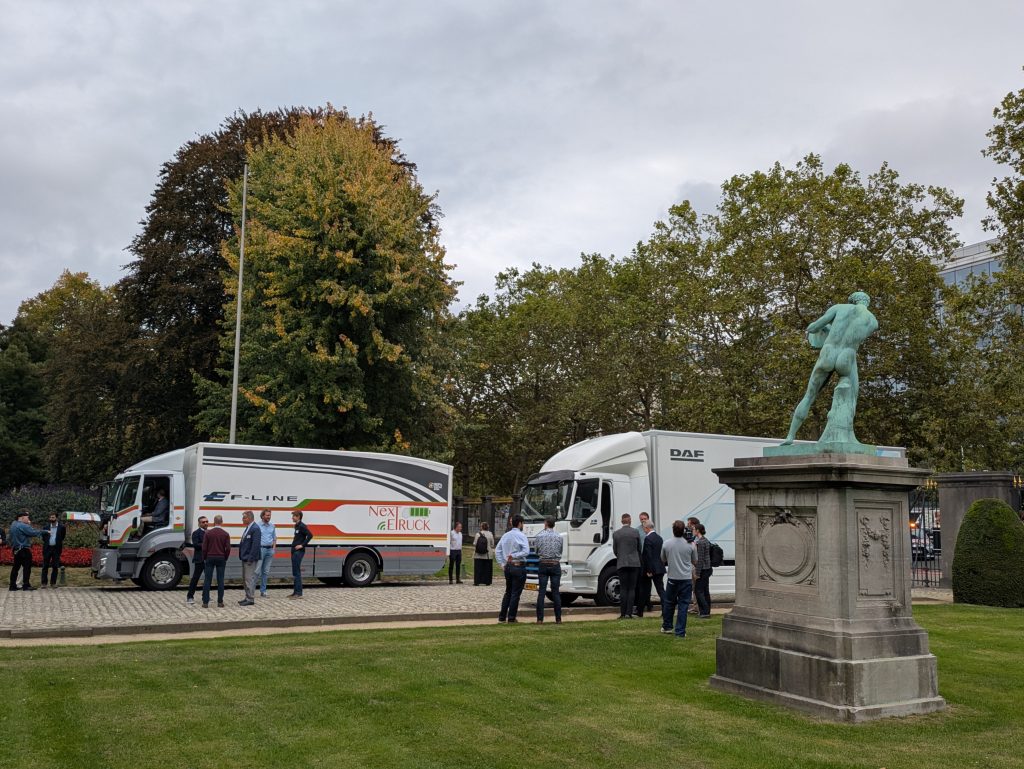
A central feature was the exhibition of the pilot vehicles in the front courtyard of the Academy Palace in Brussels. The conference was opened by the project coordinator, René Corbeij from TNO, and the responsible European Commission project officer, Susanne Lanzerstorfer, from CINEA. It underscored the innovation potential of medium sized trucks. The consortium invites readers to examine the project findings through the final brochure and the presentations listed below.



What are the main innovations of the NextETRUCK project?
Estimating range, fuel consumption and maintenance needs for internal combustion engines requires relatively few parameters. Battery electric vehicles, by contrast, demand the evaluation of battery and drivetrain performance, ambient temperature, charging speed and duration, and long term battery degradation. Digital twins collect and analyse these parameters, and they also support efficient vehicle operation by mitigating avoidable fluctuations in performance. Each of the following developments addresses a potential bottleneck to the efficient deployment and scaling of medium sized battery electric vehicles (presentations are accessible via the links):
Digital twins (AVL): A digital twin of the Ford Otosan truck’s cooling system, which exchanged data with the AVL cloud in Graz, Austria, achieved a 15% reduction in cooling power. This indicates scope for downsizing the system and lowering its cost, and the approach could be extended to other vehicle systems.
Megawatt charging tests (JEMA): The trials yielded important insights into voltage and current waveforms, switching losses and dynamic characteristics, all of which are crucial for optimising power converter design. The results form a baseline for subsequent system level integration and reliability assessments.
Charging software (K2Mobility/PANION): Planning and management solutions for electric truck charging can lower energy costs, reduce peak demand and ease grid congestion, while accommodating unforeseen changes in vehicle routes and schedules. The software also serves as a route planner that weighs the merits and drawbacks of public charging against depot provision.
Which trucks were displayed?
While our IRIZAR refuse truck was prominently featured as part of our Barcelona pilot kick-off event in September 2025, the stage was given to the DAF and Ford Otosan trucks which operated in the United Kingdom and Istanbul respectively. These two medium-sized battery-electric trucks tested a majority of the NextETRUCK innovations that are essential for the future uptake of this technology in the road freight transport sector, including digital twinning, improved thermal management and a redesigned chassis. While these innovations were mostly the focus of the vehicle built by Ford Otosan, DAF UK cooperated with external the freight companies to provide guidance for the initial uptake of battery-electric trucks in daily operations. Participants felt intrigued by the new technology and discussed the operational capacities and challenges that were overcome by the pilot runs of the trucks.
Presentations:
- Barcelona (Spain)
- Istanbul (Turkey)
- The United Kingdom

What is the overall impact of the NextETRUCK project?
Business models (CERTH): The business models of all three pilot operations were assessed, which led to the conclusion that the Istanbul truck of Ford Otosan and the UK pilot of DAF produce the strongest results due to their larger projected sales volumes, while the Barcelona use case of IRIZAR and JEMA also become economically viable as sales increase over time.
TEIDE & KITE Tools (CENEX NL): While the KITE tools helps logistics operators in small companies with less than 20 trucks who are planning to electrify their depots, the TEIDE tool allows to forecast the energy-based utilisation of chargepoints installed at en-route locations and therefore helps CPOs who are planning public charging infrastructure investments for passenger and passenger vehicles and heavy-duty vehicles.
Total cost of ownership (CENEX UK): The TCO calculations were made for all three use cases with the positive outcome that all demonstrator vehicles estimate a positive TCO against ICEV baseline.
All data points, TCO calculations and operational capacities were also assessed in more than 30 KPIs, including several indicators that are in in line with the 2Zero Partnership.
Learn more by accessing the NextETRUCK impact presentation
What conclusions does the project draw?
Given the marked expansion of the battery electric heavy-duty sector over the past five years, NextETRUCK met its objective of testing novel solutions and vehicles under sustained, everyday operating conditions. Policy frameworks have also evolved during the project’s lifetime. The consortium therefore recommends retaining the 2030 emission targets and improving grid access for depot charging, which appears to be the most significant obstacle to deploying medium sized vehicles.
Access the concluding remarks here.
Where can further information be found?
The consortium is currently completing several deliverables, many of which will be published on the website in the coming weeks. It is pleased to announce that the final brochure was officially presented at the conference. Readers are also welcome to explore the project’s news and content repository on the website.