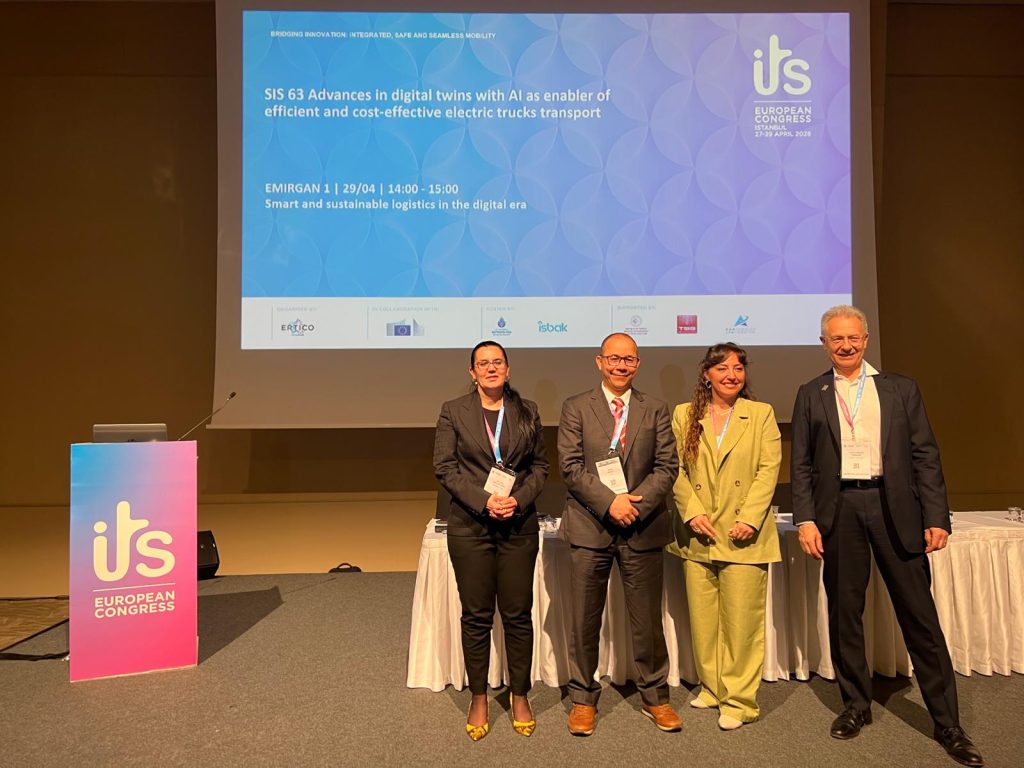
The commercial freight sector faces the challenge of meeting European climate goals. The shift toward electrification is not just a vehicle design matter, but a complex logistics and mobility challenge. Session SIS-63 at the recent ITS European Congress in Istanbul explored how Digital Twins and AI are becoming essential tools to make electric trucks cost-effective and operationally viable. The session was moderated by Jean Charles Pandazis (ERTICO – ITS Europe), with the participation of Ahu Hartavi (Surrey University), Helin Ozdemir (Ford Otosan) and Omar Hegazy (VUB), who shared insights from the AEVETO Cluster projects NextETRUCK, ESCALATE and ZEFES.
A Digital Twin is more than a digital representation of the physical world. It is a dynamic representation that uses AI to analyse, learn, and predict. By integrating real-time data, these twins can optimise energy consumption and charging strategies, predict failures through predictive maintenance and improve decision-making.
Key benefits across the value chain
These digital solutions bring advantages across the transport ecosystem. For OEMs like Ford Otosan, the key vehicle manufacturer behind NextETRUCK’s Istanbul pilot, digital validation allows for faster product validation, reducing the need for physical prototypes. They are also relevant to operational efficiency (energy optimisation, charging strategies, maintenance planning, etcetera). For fleet customers, these technologies translate into a lower Total Cost of Ownership (TCO) by leveraging predictive maintenance and energy-optimal operations. Finally, logistics operators benefit from the vehicle data integration with warehouse systems, charging infrastructure and delivery networks, enabling a more efficient management of the supply chain.
Projects highlights and tools
- NextETRUCK: Demonstrated a “Digital Twin Uptime” model where vehicle data is sent to the cloud for AI optimisation, which then feeds back to the vehicle to improve quantities like energy efficiency (noting a 1% energy consumption efficiency increase and a 13% TMS efficiency increase).
- ESCALATE: Introduced a suite of tools including TwinSphere (plug-and-play digital twins), GreenFleetTCO for cost intelligence, and ZeroPath for range estimation.
- ZEFES: Showcased a “Buying Decision Tool” to help operators navigate the transition to zero-emission vehicles.
Challenges and Future Considerations
Despite the technical progress, several hurdles remain for further uptake. Standardisation, interoperability and scalability across the value chain are critical needs. Furthermore, as these systems become more connected, cybersecurity must be treated as a priority.
Looking forward, the industry must also address the “cost of AI” itself, balancing the energy required to run complex models with the sustainability goals while remaining compliant with the emerging Data AI Act.