

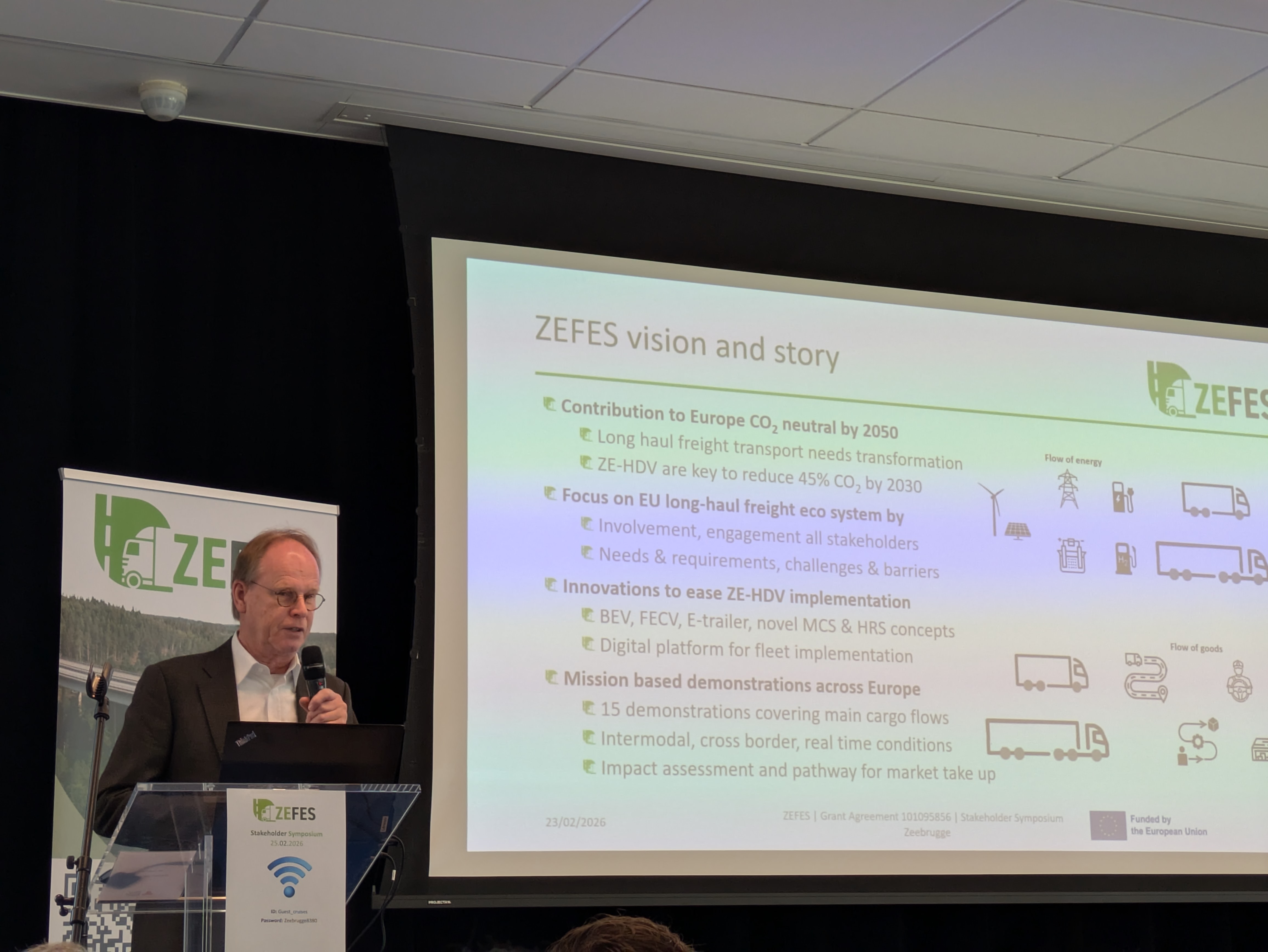
As part of the AEVETO cluster, NextETRUCK partner POLIS accepted the invitation of the ZEFES project to attend its annual symposium, held at the Belgian coastal port of Zeebrugge.
Similar to the 2024 edition, the symposium brought together numerous ZEFES project partners, industry experts, stakeholders and AEVETO partners. Participants were updated on the progress of several long-haul cross-border operations using battery-electric trucks, carried out by freight and consumer goods companies including ECS and Procter & Gamble. Both organisations are partners in the ZEFES project and hosted this year’s event and live demonstration.

ZEFES Objectives: scaling zero-emission long-haul transport across Europe
With its pilot operations in Zeebrugge and along other major European routes, ZEFES aims to make a tangible contribution to Europe’s climate neutrality objectives. The project addresses persistent challenges associated with complex cross-border freight routes, where infrastructure gaps and regulatory fragmentation continue to hinder seamless operations.
By concentrating on key European road freight corridors, ZEFES seeks to generate replicable solutions that facilitate broader market uptake of zero-emission heavy-duty vehicles.
A central component of the pilots is the systematic testing of battery-electric trucks and megawatt charging systems under real-life operational conditions. These demonstrations are designed to assess technical performance, operational feasibility and infrastructure readiness at scale. As Ben Kraaijenhagen, ZEFES project coordinator, summarised: “We need to resolve the issues arising from fragmented infrastructure and legislation along our cross-border routes.”
More Than a Dozen Demonstrations Under Real-World Conditions
The project currently encompasses more than a dozen demonstration activities across Europe. These include, among others, Volvo’s factory-to-factory route between Gothenburg and Ghent, which incorporates a ferry crossing, as well as a comparable long-distance route operated by Scania between Sweden and the Netherlands. Additional trials are being conducted on several other routes, trips through mountainous terrain in France, which will test the capacity of zHGVs.
Across these varied operational contexts, vehicles are being tested to their functional limits. The demonstrations cover megawatt charging technology, next-generation drivetrain systems and advanced trailer configurations. Further pilot routes and technical validations are supported by additional zero-emission heavy goods vehicle (zHGV) OEMs and technology providers, including Renault, Ford Otosan, Fraunhofer and Hitachi Energy.
Live Demonstrations at the Port of Zeebrugge
The practical demonstrations in Zeebrugge took place within the Belgian port area at the premises of ECS, a family-owned logistics company specialising in services for several British supermarket chains. As explained by Cédric Lanckriet of ECS “the company has effectively created a consolidation hub that enables efficient, rapid and climate-friendly maritime shipping to multiple ports in the British Isles”. Operating from Zeebrugge also provides a strategic alternative to the Dover–Calais bottleneck.
During the site visit, ECS employees presented one of their multimodal logistics facilities, primarily serving the German supermarket retailer ALDI. The installation includes a high-bay warehouse and dedicated loading and unloading infrastructure for goods transported by road and rail.
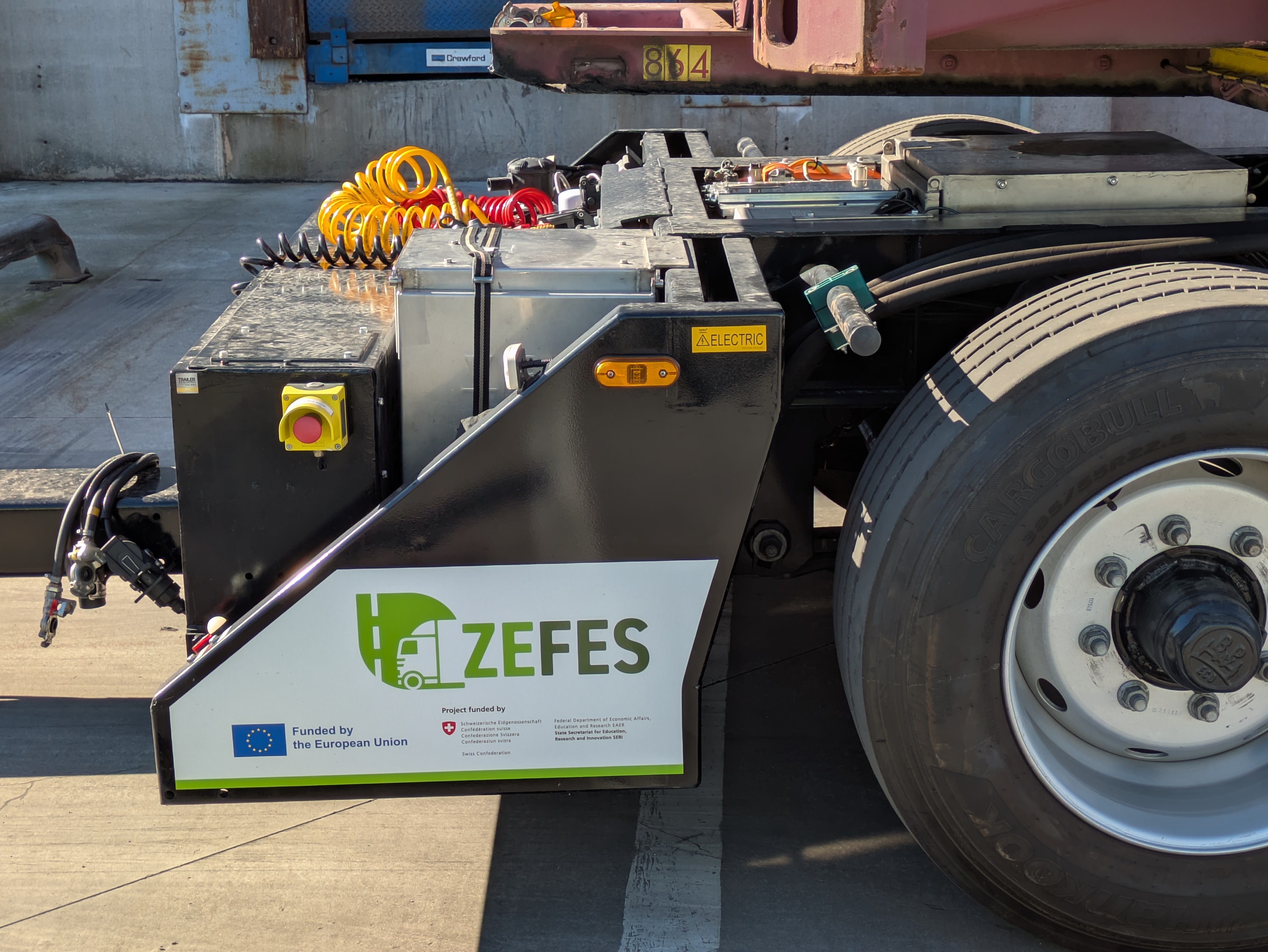
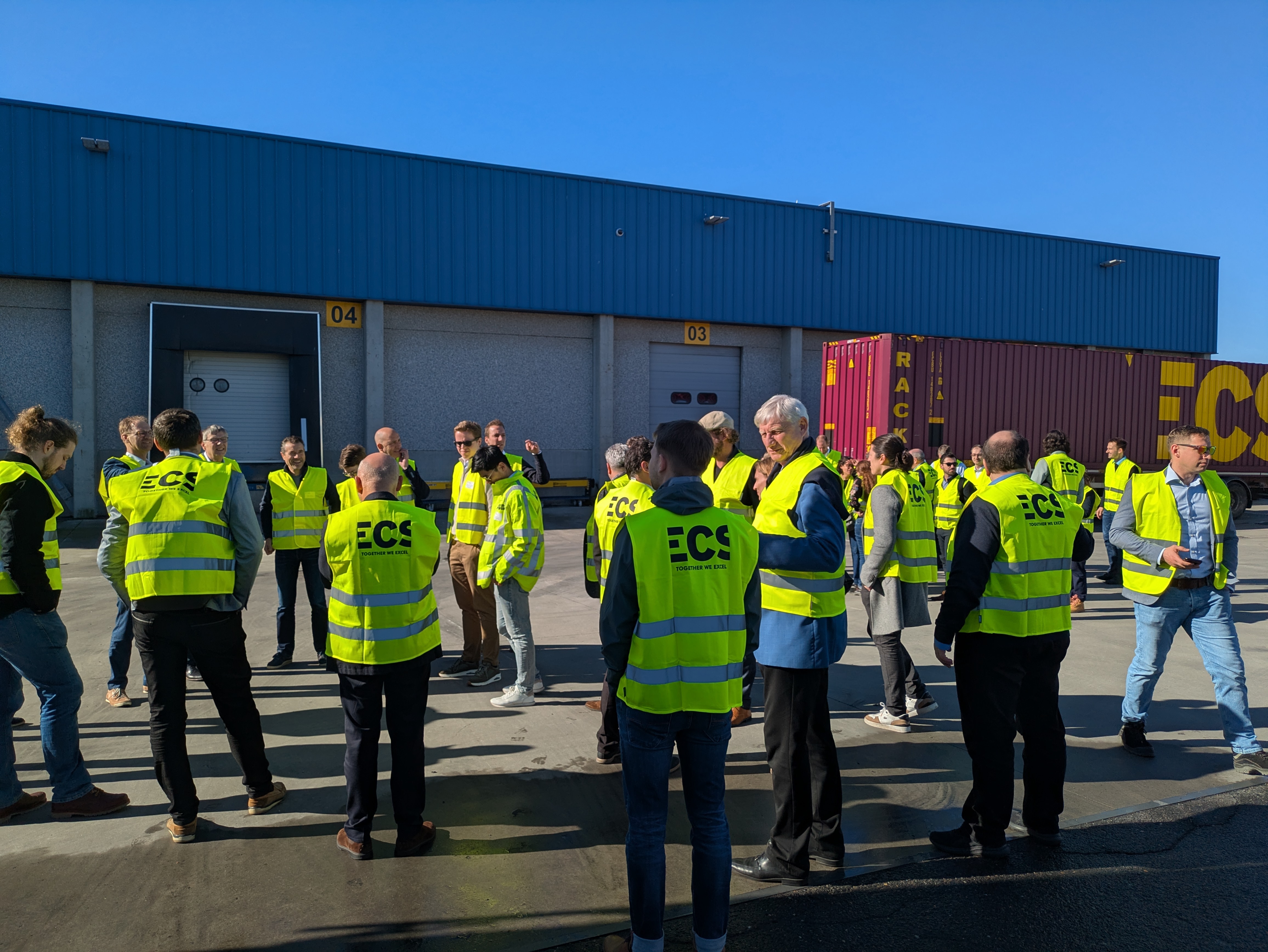
In addition, long-haul battery-electric trucks from Volvo and Scania were showcased. The vehicles were charged using a megawatt charging system (MCS), enabling charging capacities of up to 1.2 megawatts, distributed across two charging plugs.
A further innovation presented was the e-dolly system, which allows trailers to be manoeuvred remotely within depot environments. This solution, currently also under evaluation at the container terminal in Dudelange, Luxembourg, is particularly advantageous for unloading operations and for handling trucks equipped with additional trailers.
NextETRUCK intends to continue its exchange with ZEFES and other AEVETO cluster projects, including through planned joint dissemination activities in Budapest at the forthcoming Transport Research Arena 2026.